
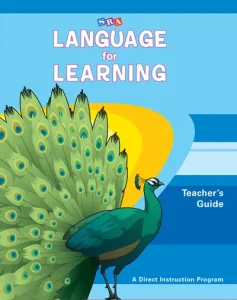
 Language for Learning is a continuation of the DISTAR Language I program. The program is designed to teach young children (pre-kindergarten through second grade) the basic vocabulary, concepts, and sentence structures used in typical classroom instruction. Language for Learning is a highly systematic and explicit program. New content is introduced carefully and integrated with previously taught content. The focus of Language for Learning is oral expression. Daily exercises provide the building blocks of listening and reading comprehension by teaching the language of instruction (the phrases and vocabulary used by teachers in instructional settings), word knowledge, common information, concepts, sentence forms, classification, and problem solving. All skills and concepts taught are continuously integrated into more sophisticated exercises.
The program can be used with four-year-old children in preschool programs, primary-age children in bilingual and ESL programs, primary-age children in Title I and Special Education programs, and children in speech correction and language classes.